
Collaborative Process
All new collaborations begin with a submission through the CCBR Project Request Form. After submission, CCBR leadership reviews each request and may accept, decline, or redirect it based on scientific fit, feasibility, and available capacity.
Eligibility: CCBR services are available to CCR Principal Investigators and their laboratory groups at NCI. CCBR does not currently support extramural researchers or other NIH Institutes/Centers outside of specific inter-institute agreements.
The best results come from early consultation. CCBR can help with experimental design and sample size planning before experiments begin.
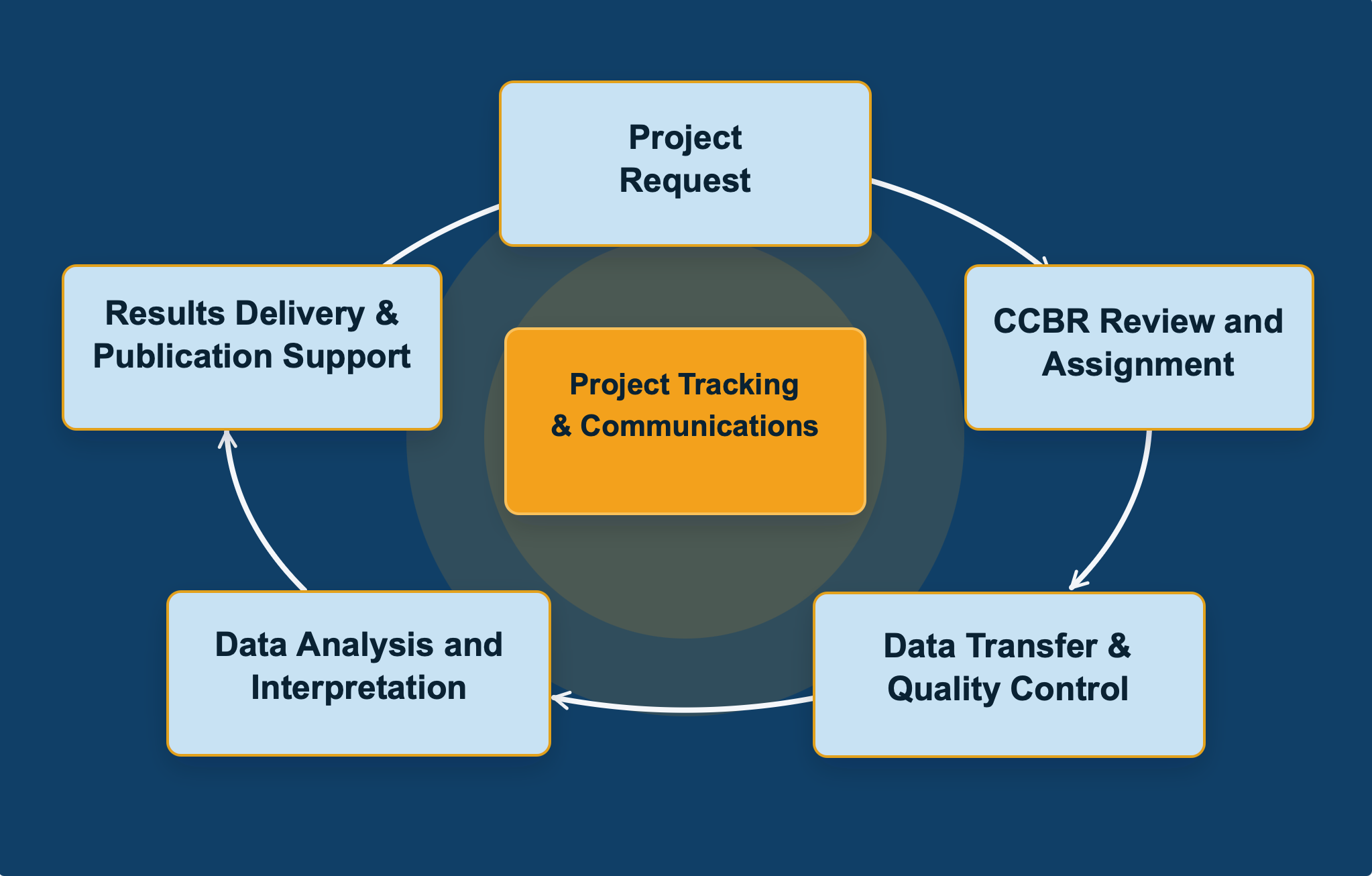
What happens after submission
Project Request
The investigator initiates a project request through the CCBR Project Request Form, outlining the scientific goals, assay type, timeline, and key project details.
CCBR Review and Assignment
CCBR leadership reviews the request for scientific fit, feasibility, and staffing, then assigns the project to the most appropriate bioinformatician or team.
Data Transfer & Quality Control
Once a project is accepted, raw data and metadata are transferred to the analysis environment, and CCBR performs initial quality control checks before downstream analysis begins.
Data Analysis and Interpretation
CCBR carries out the agreed analytical workflow, works with the investigator to interpret the results, and refines analyses as needed through iterative discussion.
Results Delivery & Publication Support
Final outputs, figures, and documentation are shared with the research team, with follow-up support available for manuscript preparation, revisions, and publication.
Request a CCBR Project
Project capacity policy: To support equitable access across CCR, ACICR guidance limits each PI to no more than two active concurrent CCBR projects at a time. Project requests may be submitted at any time, but a new project will begin only when the PI has fewer than 2 active projects.
CCBR Project Request Form
Hosted on the NCI internal portal. An NIH login is required to access the form. If you are off the NIH network, you must also connect through NIH VPN.
Access the Project Request Form →What to include in your request
Project Basics
- PI name, lab, and CCR lab/division
- Project title and brief scientific background
- Data type(s): Bulk RNA-seq, ChIP-seq, WES, scRNA-seq, etc.
- Number of samples and conditions
- Current project status
Analysis Planning
- Analysis goals and specific questions to address
- Relevant publications or preliminary data
- Desired timeline or deadlines (grant, paper submission)
Request Prioritization Guidelines
CCBR uses a structured prioritization framework to allocate resources fairly and efficiently across CCR.
- Scientific impact — alignment with CCR/NCI research priorities
- Time sensitivity — grant renewals, paper submission timelines, or clinical decision points
- Project readiness — availability of complete project details and experimental information at the time of submission
- Feasibility — technical feasibility given available CCBR resources and expertise
- Equity — equitable access across CCR investigators, including those new to CCBR